Mark, I also see the current modem communication layer as a problem source. The read buffer only takes 128 bytes, which will not be sufficient for many situations -- e.g. a GPS response now needs already two NMEA sentences adding up to about 108 bytes -- come in another modem answer before the buffer gets handled, and bang we go... The multiplex mode is quite interesting, didn't know this before -- although a really fully asynchronous modem comm handling would not need that, I think. But it would need more buffer RAM... Hm... the SIM908 manual says: "In Multiplex mode, it is recommended to use the hardware flow control." As far as I understand the circuit schemes the current hardware does not connect RTS/CTS (pins 66+67) -- right? Regards, Michael Am 30.04.2013 03:28, schrieb Mark Webb-Johnson:
Michael,
Looking at the design for 3G modules, I noticed something recommended for those modules that seems to be supported for the SIM900 base we use (both SIM900 OVMS v1 and SIM908 OVMS v2). CMUX mode.
http://www.m2m-platforms.com/seminars/2007seminar_material/Telit_CMUX_2_M2M_...
This is GSM 7.10 TE-MS multiplexor protocol.
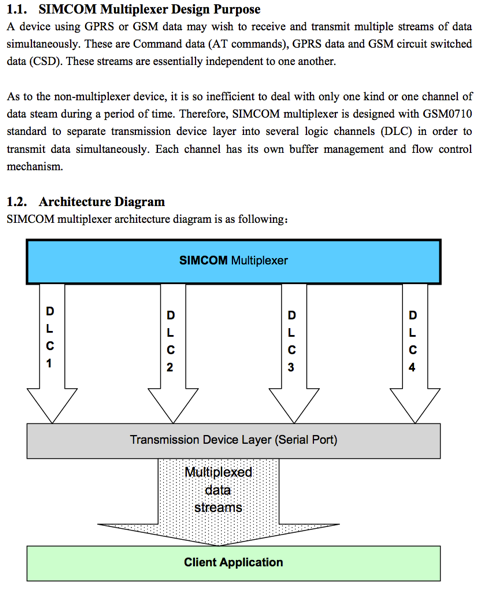
The main problem we have is co-ordinating all the different comms channels of OVMS onto a single serial link to the modem. Incoming SMSes, status indicators, outgoing GPRS TCP data, etc, all run over each other.
The CMUX protocol appears to allow us to have 3 (or 4?) virtual async links, over a single physical async port. We could use one for SMS, another for TCP, and a third for GPS polling. The 3G modules even allow the GPS NMEA data to be streamed back over one of the virtual ports (but I don't think that is available in the SIM908 module we use - hard to tell as the CMUX documents focus on SIM900 not SIM908 [the SIM908 embeds SIM900 and adds GPS]).
It would mean some major restructuring of the comms layer (NET), and we would have to build a small library to encode/decode GSM 7.10, but may be a much more stable approach in the long-term.
SIMCOM seem to implement a subset of the full GSM 7.10 functionality. Here's the manual on it for SIM900:
http://www.mt-system.ru/sites/default/files/sim900_multiplexer_user_manual_a...
Regards, Mark.
On 29 Apr, 2013, at 11:48 PM, Michael Balzer wrote:
Am 28.04.2013 17:06, schrieb Michael Balzer:
I just checked in my fix for the USSD reply handler. My tests with streaming enabled did not produce any more crashes, so I think that was the problem.
I was wrong, it's still crashing. I have to dig deeper it seems.
Has anyone observed crashes with streaming mode on other vehicles, or is this a Twizy specific bug now?
Thanks, Michael
-- Michael Balzer * Paradestr. 8 * D-42107 Wuppertal Fon 0202 / 272 2201 * Handy 0176 / 206 989 26 <dexter.vcf>_______________________________________________ OvmsDev mailing list OvmsDev@lists.teslaclub.hk <mailto:OvmsDev@lists.teslaclub.hk> http://lists.teslaclub.hk/mailman/listinfo/ovmsdev
_______________________________________________ OvmsDev mailing list OvmsDev@lists.teslaclub.hk http://lists.teslaclub.hk/mailman/listinfo/ovmsdev
-- Michael Balzer * Paradestr. 8 * D-42107 Wuppertal Fon 0202 / 272 2201 * Handy 0176 / 206 989 26