The metrics subscription scheme is an option, and the auto-subscribe feature via a getter is a nice idea. But I wouldn't apply that to metrics value conversions and units. Also we would still need the current set of metrics to be subscribed by default, as there are also non Javascript devices (e.g. smart buttons, Wifi displays) reading the WebSocket stream. My thoughts on this so far: Basically the web UI, as any frontend, should adapt to unit configurations seamlessly. The web UI includes many command outputs, which already automatically switch units as configured. For all practical purposes, the web UI needs to interact with users in their preferred units. Only some plugins and functions will need certain values in metric (native) units for calculations, and these will also need a simple way to convert calculation results back to user units for displaying. So I think we need to provide the unit configuration and value conversion tools in the web framework as well. Proposal: a) We provide a config option and a WebSocket command to switch the WebSocket metrics transmission mode to user / native units. To keep plugin compatibility, the default is 'native'. b) We introduce a separate units dictionary object containing the user units for both metrics and the unit groups in their code & label representation. The units dictionary only needs to be sent initially, when new metrics are registered, when the metrics mode is changed for the current connection, and when some user unit configuration is changed, keeping the bandwidth and processing requirements low. The units dictionary can combine both metrics and group units, as the unit group names are fully distinct from the metrics namespace. The transport scheme could be: { units: { "v.p.speed": { code: "kmph", label: "km/h" }, … "units.distance": { code: "miles", label: "M" }, … } c) In the web framework, accessing units should be as simple as possible and avoid throwing exceptions for undefined entries, so we could e.g. split these into separate code & label objects: units["v.p.speed"] = "km/h" // consistently accompanies metrics["v.p.speed"] unitcodes["v.p.speed"] = "kmph" units["units.distance"] = "M" unitcodes["units.distance"] = "miles" …or provide a getter that tests for the key existence and returns an object with empty fields as necessary. With this, all metrics displays can easily be changed to display the actual unit labels instead of using fixed strings. d) To provide value conversion we implement UnitConvert() in Javascript plus some wrappers that automatically look up the unit for a given metrics/group name and do the conversion to/from native units, something like… var speed_kph = toNativeValue("v.p.speed"); // optional second arg to convert any data var speed_kph = metrics_native["v.p.speed"]; // using a getter var trip_display = toUserValue("units.distance", 1234); Plugins for scientific/technical applications that depend on native (metric) units can use the new metrics transmission mode control command to force native mode. Or they can choose to migrate from "metrics[]" to "metrics_native[]". The metrics mode config option can come with a note informing users that there may be some old plugins not compatible with non-native units. They can then check their plugins for this and make an informed decision on wether to enable user units and/or wether to install a specific plugin. Thoughts, comments? Regards, Michael Am 25.11.22 um 03:13 schrieb Michael Geddes:
I have an idea which might reduce traffic for maintaining the metrics[] array in the browser and cope with the user units. I'll start by saying I'm not a JS developer per se.. so a newb in JS really. Still, it's mainly just another language so .. we'll give it a go.
Firstly: * Implement the 'changed' filters as below for the web-socket.. for both normal and 'user' values. * Add a function that subscribes to a value (and returns the current value of it)..including to 'user' value/unitlabel.
Subscribing the normal way to the metrics over the websocket would have the normal effect.. but we would have a new way that would subscribe in a filtered way.
I've had a little play with the Proxy object .. so at least I know this should work:
Have a metrics_ array that is the real associative array for metrics[] and then define a Proxy that has (at the least) 'get' and 'has' defined (giving us the ability to overload /metrics['prop']/ and /"prop" in metrics operations/).
The /get /function would return the underlying value if it exists in the /metrics_ /array (which is maintained through the websocket from currently subscribed values in the current manner). If the value is not in the /metrics_/ array - it would then do a subscribe+query on the websocket getting the current value and adding it into the /metrics_/ container. If it was unavailable then it would put /undefined/ into the array. The 'has' would do the get() and return true if the value was not == /undefined/.
For the 'query the websocket' bit, I'm assuming I would be working with promises or futures or some such: I'll do the research and do it properly unless somebody can help me out with it. That's the bit I was going to work on next for the proof-of-concept.
Any immediate thoughts? Dangers?
I also noticed there was a bit that went through html element properties and looked for metrics .. this could be used to bulk subscribe to any metric values required there.
//.ichael
On Thu, 17 Nov 2022 at 07:52, Michael Geddes <frog@bunyip.wheelycreek.net> wrote:
Yeah, ok.
I will get all the other 'user unit' stuff done as a line in the sand, and then move to working out the web stuff. I'm still finding my way though all the client side javascript, which looks very cool.. but I've not really done jQuery before (just enough to recognise it).
Subscribing to metrics with/without user units makes a lot of sense. Obviously the default needs to be 'Subscribe to all metrics but not user units' to maintain compatibility... but I was also thinking it might be nice if we could filter down even the normal subscribed events. We could have: * Web socket command to filter units (flag on websocket to say 'filtered' + flag bitset on each metric similar to 'dirty') Then either: * Web socket command to turn on user units (single flag on that websocket) or * Web socket command to turn on user units for specific metrics (flag bitset on each metric)
A parameter to the URI for the websocket could start the socket in 'filtered' mode to avoid the initial rush of metrics.
This could drastically reduce traffic and time for the metrics command to execute. It would be possible to also check (on a 'filtered' websocket) for any changes to metrics for that websocket slot before queueing the 'metric update' socket command.
//.ichael
On Thu, 17 Nov 2022 at 00:35, Michael Balzer <dexter@expeedo.de> wrote:
Michael,
I don't have much spare time currently, just some quick first comments: it's important to implement this as lightweight as possible, both in terms of network load and client CPU & memory requirements. Some devices already have issues, which can be seen by the "websocket overflow" messages. The web UI also should stay usable via cellular.
My impression is the new scheme, while only slightly raising the client requirements, adds substantially to the network requirements.
An option could be to separate the units -- or more, back when implementing this I thought about separating the names later on. Another question is if we normally generally need both the native and the converted values in the web UI. We maybe could provide an option to switch to converted values, or add an option to retreive or subscribe to a set of converted metrics on demand.
Standard plugins like ABRP and PwrMon rely on getting metric (native) units, and there probably are non-public plugins, e.g. for engineering & scientific projects, that depend on metric units to do their calculations and don't need anything else. We shouldn't make life harder for these applications without good reason.
Regards, Michael
Am 15.11.22 um 01:26 schrieb Michael Geddes:
If you're ok with the [default] option I'll stick with that. I mean in some ways it would be nice to have a button choice metric | usa | europe | asia | custom etc and I kind of considered something like that but figured it's only a handful of choices.. and it's an embedded device.. so simpler is better.
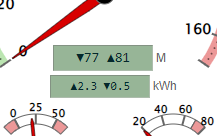
On a related note - I was thinking how it would be nice if the dashboard (etc) had access to the 'user' units, so went hunting down that little rabbit hole. Quite a nice mechanism with the web socket updating the "metrics" object in the UI. This is a snippet of one idea, which is that for any metric that has the possibility of a user unit, we set the extra values of the metric with '#unit' and '#user' appended - see below. (I've chosen '#' arbitrarily.. but it could be '/' or ':' or '>' but maybe not '.' )
v.p.odometer#unit: "M" v.p.odometer#user: 6754.91 v.p.satcount: 13 v.p.speed: 0 v.p.speed#unit: "km/h" v.p.speed#user: null *v.p.trip: 28* *v.p.trip#unit: "M" v.p.trip#user: 17.3984*
Then we can use this in the dials to populate the values and captions! (not that I like Miles). I
image.png
The other (similar) way was to have something like the following: "v.p.trip#user" : { "value": 17.3984, "unit": "M" } It wouldn't make the total message any shorter.. soo.. dunno.
There's also some complications with setting up the dials (for min/max values) - like for the speed.
Notice also that I'm returning null for undefined values. It's nice - but I'm not sure how javascript handles null when used / printed etc.
//.ichael
On Sun, 13 Nov 2022 at 21:06, Michael Balzer <dexter@expeedo.de> wrote:
Michael,
looks good.
I think having an explicit 'default' option is better than taking the 'Metric' equivalent for that, as in your example you already show unit alternatives within the metric system to support different scalings (kW / W, kWh / Wh). (Btw… waiting for someone to miss Horsepower & BTU here ;-))
@Patrick, I think that also answers your implicit question:
The default button makes it unclear what the actual setting is.
The default (native unit) is always metric, but you may have a mix of scalings, as we try to find the one that fits best for the given application when defining a metric. For example the current driving energy consumption is stored natively in Wh/km, while the energy used or regenerated is in kWh, and the odometer & trip counters are in km, while the altitude ist in m.
Regards, Michael
Am 13.11.22 um 08:42 schrieb Michael Geddes:
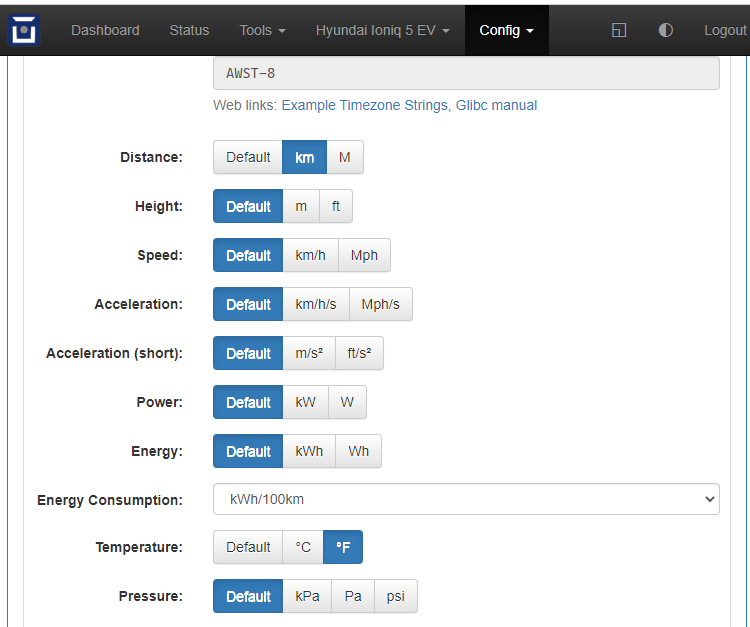
Greetings, so this is my idea of being able to select which units various groups use (in addition to Distance). This can be then accessed by the special 'user' unit code. (or 'metrics list -u ' ) The idea of [Default] selection below simply means storing the value to blank - meaning use whatever unit the particular metric uses. The other idea I had was to actually default it to the equivalent of 'Metric' special unit code and not have the [Default] button.
image.png
Currently I've made it so that if there are more than 3 choices other than [default] that it uses the choice/combo box rather than the Radio buttons. (ie this list is auto-generated from the Metric Units table and the Metric Groups table).
Thoughts / comments?
//.ichael
On Sat, 12 Nov 2022 at 17:35, Michael Geddes <frog@bunyip.wheelycreek.net> wrote:
https://github.com/openvehicles/Open-Vehicle-Monitoring-System-3/pull/771
I'm hoping this P/R is ok in this form (made of 5 separate commits).
I will have a look at implementing the "user" unit code. The base for how it would work is already a part of the above pull request. I'll just look at the module configuration for distance.
The 'power consumption' is one where it's not just a check-box.. there're 5 possible choice!
I should also add 'bar' for pressure given that for some reason that's still a thing people want.
//.ichael
On Sat, 12 Nov 2022 at 16:24, Michael Balzer <dexter@expeedo.de> wrote:
I think this is pretty decent & complete now.
I also like the approach of the 'user' unit code. Moving all user unit prefs into the module configuration is an old todo. Currently only the distance unit is defined at the module side, temperature and pressure are App prefs.
Regards, Michael
Am 11.11.22 um 09:54 schrieb Michael Geddes:
Ok - so here's what I have implemented for Duktape and Metrics. (I added IsDefined() as well). Any thoughts on this?
Noting OvmsMetrics.Float( {metric} ) -> Outputs metric as float (same) OvmsMetrics.Float( {metric}, {unit}) -> Outputs metric as float converted to given unit (new) OvmsMetrics.Value( {metric} ) -> Outputs Metric in native value (same) OvmsMetrics.Value( {metric} , false) -> Outputs Metric as string and no units (same) OvmsMetrics.Value( {metric} , {unit}) -> Outputs Metric converted to given unit as native value. (new) OvmsMetrics.Value( {metric} , {unit}, false ) -> Outputs Metric converted to given unit as string including any unit specifier. (new) also OvmsMetric.GetValues( {metric} [,{unit}] [, {converted} ] ) Adds similar behaviour to Value() above. also the special units '*imperial*' and '*metric*' will convert to the associated imperial / metric version of the units as appropriate.
(function() { dump = function (metric) { print( metric+ " ["+(typeof metric)+"]\n" ); } dump_obj = function (obj ) { print('--- Object ----\n') for (var k in obj) { xk = obj[k]; print( k+':'+ xk + ' ['+typeof xk+ "]\n"); } } dump(OvmsMetrics.Value("xiq.v.trip.consumption")); dump(OvmsMetrics.Value("xiq.v.trip.consumption", false)); dump(OvmsMetrics.Value("xiq.v.trip.consumption","kmpkwh")); dump(OvmsMetrics.Value("xiq.v.trip.consumption", "mipkwh", false)); dump(OvmsMetrics.AsFloat("xiq.v.trip.consumption")); dump(OvmsMetrics.AsFloat("xiq.v.trip.consumption","kmpkwh")); dump(OvmsMetrics.Value("xiq.v.trip.consumption","imperial")) dump(OvmsMetrics.Value("xiq.v.trip.consumption","imperial", false)) dump_obj(OvmsMetrics.GetValues("trip", "metric")) dump_obj(OvmsMetrics.GetValues("trip", "imperial", false)) })();
With this output: 19.2308 [number] 19.2308 [string] 5.2 [number] 3.23112mi/kWh [string] 19.2308 [number] 5.2 [number] 309.49 [number] 309.49Wh/mi [string] --- Object ---- v.p.trip:13 [number] xiq.e.trip:0 [number] xiq.e.trip.energy.recuperated:0 [number] xiq.e.trip.energy.used:0 [number] xiq.v.trip.consumption:19.2308 [number] --- Object ---- v.p.trip:8.07781M [string] xiq.e.trip:0M [string] xiq.e.trip.energy.recuperated:0kWh [string] xiq.e.trip.energy.used:0kWh [string] xiq.v.trip.consumption:309.49Wh/mi [string]
On Wed, 9 Nov 2022 at 05:47, Michael Geddes <frog@bunyip.wheelycreek.net> wrote:
Yeah - I like HasValue. I implemented IsDefined() but I will rename it.. that's a much clearer name.
Another thought. How about if we did this (but also with GetValues() as well - see the special values below)
OvmsMetrics.Value("xiq.v.trip.consumption", true) -> 17.0582 (Number) OvmsMetrics.Value("xiq.v.trip.consumption", false) -> 17.0582 (String) OvmsMetrics.Value("xiq.v.trip.consumption", "mipkwh", true) -> 3.64264 (Number) OvmsMetrics.Value("xiq.v.trip.consumption", "mipkwh", false) -> 3.64264Mi/kWh (String) OvmsMetrics.Value("xiq.v.trip.consumption", "native", false) -> 17.0582km/kWh (String)
and OvmsMetrics.Value("xiq.v.trip.consumption", "imperial", false) -> 3.64264Mi/kWh (String)
I have already implemented the special values 'native' (existing), 'imperial' and 'metric'.
I was also thinking that in the future you could have 'user'. Where for each group of values: 'temperature', 'distance', 'shortdistance', 'power' etc.. you could have a user preference. I probably won't implement it now,.but it could be cool that any UI could just ask for the user defined units (rather than having a separate choice).
//.ichael
On Tue, 8 Nov 2022 at 21:57, Mark Webb-Johnson <mark@webb-johnson.net> wrote:
Or perhaps something more specific?
HasValue()
Mark
On 8 Nov 2022, at 9:01 PM, Michael Balzer <dexter@expeedo.de> wrote:
Signed PGP part That's basically a good approach, but be aware 'IsDefined()' has an ambiguous meaning here, as with the API stem "OvmsMetrics" it would naturally be expected to mean "is this metric defined", not "does this metric have a defined value".
An undefined metric currently can be derived from 'Values()' returning undefined, but that's more an undocumented side effect than intended.
Maybe 'GetDefined()' could be a better name, leveraging this behaviour, i.e. returning 'undefined' for an actually undefined metric, and 'null' for a defined metric without a value.
Regards, Michael
Am 08.11.22 um 13:46 schrieb Michael Geddes:
Ah yes. Arrays - will check those. Yeah, how about we add a 'IsDefined' method to metrics instead of the null thing (it does sound like it will upset too many applecarts).
//.
On Tue, 8 Nov 2022 at 20:35, Michael Balzer <dexter@expeedo.de> wrote:
Michael,
looks all good to me, once again nice find with the decode argument. Adding decode to the Value() call was only for symmetry IIRC, the main use was with GetValues() (https://docs.openvehicles.com/en/latest/userguide/scripting.html#ovmsmetrics).
Don't forget to test arrays, e.g. "v.t.pressure" & "v.t.temp".
Returning null for an undefined metric seems like a natural choice, but is a rather deep change, as for consistency not only the Duktape metrics API but also the Web UI metrics API would need to be changed accordingly. Unless you've got a real use case that needs that, we should be careful.
Regards, Michael
Am 07.11.22 um 15:00 schrieb Michael Geddes: > I have figured out a bunch of > stuff and have implemented the > following: (having done away > with needing AsFloatUnit) > > OvmsMetrics.Value( {metric} [, > {decode}]) > OvmsMetrics.Value( {metric}, > {unit} [,{decode}]) > > It turns out that the [decode] > flag wasn't working anyway > (since the function was being > registered as only having 1 > param)... > This way it is still really 1 > function.. but I check it the > second parameter is a 'boolean', > and if not.. try the second form. > > OvmsMetrics.AsFloat( {metric} > [,{unit}] ) > > and add the function > > Ovms.Metrics.ValueUnit( {metric} > [,{unit}]) > This prints the value and the unit. > > Here's a sample function and the > output! This also shows the > types of the output. > > (function() { > x = > OvmsMetrics.Value("xiq.v.trip.consumption"); > print( (typeof x) + ": "+ > x+"\n" ); > x = > OvmsMetrics.Value("xiq.v.trip.consumption", > false); > print( (typeof x) + ": "+ x > +"\n" ); > x = > OvmsMetrics.Value("xiq.v.trip.consumption","kmpkwh") > print( (typeof x) + ": "+ x > +"\n"); > x = > OvmsMetrics.Value("xiq.v.trip.consumption", > "mipkwh", false) > print( (typeof x) + ": "+ x > +"\n"); > x = > OvmsMetrics.ValueUnit("xiq.v.trip.consumption") > print( (typeof x) + ": "+ x > +"\n"); > x = > OvmsMetrics.ValueUnit("xiq.v.trip.consumption","mipkwh") > print( (typeof x) + ": "+ x > +"\n"); > x = > OvmsMetrics.AsFloat("xiq.v.trip.consumption") > print( (typeof x) + ": "+ x > +"\n"); > x = > OvmsMetrics.AsFloat("xiq.v.trip.consumption","kmpkwh") > print( (typeof x) + ": "+ x > +"\n"); > })(); > > number: 17.0582 > string: 17.0582 > number: 5.86227 > string: 3.64264 > string: 17.0582kWh/100km > string: 3.64264mi/kWh > number: 17.0582 > number: 5.86227 > > > It still might be an idea to use > 'null' as a return value if the > metrics is!IsDefined() but that > would be changing the existing > behaviour slightly. > > //.ichael > > On Mon, 7 Nov 2022 at 08:12, > Michael Geddes > <frog@bunyip.wheelycreek.net> wrote: > > I've worked out what the > decode flag is for and how > it works, and I think how > optional params work. > I'm pretty sure I won't > need the 'AsFloatUnit' > function; the unit would be > an option to AsFloat(); I'll > know that soon. > > The 'Value' function is more > complicated because of the > optional decode bool. I > guess I could add the Unit > to the end of that. > > ValueUnit could be still > useful then to provide a > 'Value + Unit'. > > Question: Is there a reason > we shouldn't be returning > with duk_push_null if the > metric !IsDefined() in both > AsFloat() and > Value(metric,true) cases? > > //.ichael > > On Sun, 6 Nov 2022 at 11:22, > Michael Geddes > <frog@bunyip.wheelycreek.net> > wrote: > > Right, so I've > implemented some stuff > that seems to work quite > well. > > https://github.com/openvehicles/Open-Vehicle-Monitoring-System-3/pull/764 > should be ready now > after a couple of stupid > mistakes slipped > through. This > absolutely needs > somebody to review it > please! (There's a > reason why I've > converted some if()'s to > switch() - which is that > it will be used in the > follow-up commit). > > The commit that will > follow on from that it > implements the new > Units: kWh/100km, > km/kWh and mi/kWh. > > This is a summary of > what I've implemented > for scripting - > including showing the > unit codes I have > so far. I've considered > a few things: > * Should some of the > longer unit codes be > shortened (eg mi, mins, > m, ft, deg, perc) > * The unit codes could > be much more regular and > separated by dots eg: > watthours -> w.h > kwhp100km -> kw.h_100km > or kw.h/100km > miph -> mi_h or > mi/h (or should it be mph). > psi -> p_in.in > <http://p_in.in/> or > p/in.in <http://in.in/> > or lb_in.in > <http://lb_in.in/> (yes, > slightly weird, but > predictable) > > *OVMS# metric units* > km : km > miles : M > meters : m > feet : ft > celcius : °C > fahrenheit : °F > kpa : kPa > pa : Pa > psi : psi > volts : V > amps : A > amphours: Ah > kw : kW > kwh : kWh > watts : W > watthours: Wh > seconds : Sec > minutes : Min > hours : Hour > utc : UTC > degrees : ° > kmph : km/h > miph: Mph > kmphps: km/h/s > miphps: Mph/s > mpss : m/s² > dbm : dBm > sq : sq > percent : % > whpkm : Wh/km > whpmi: Wh/mi > kwhp100km : kWh/100km > kmpkwh: km/kWh > mipkwh: mi/kWh > nm : Nm > > *OVMS# metric unit mi* > miles : M > minutes : Min > miph : Mph > miphps : Mph/s > whpmi : Wh/mi > mipkwh : mi/kWh > > *OVMS# metric get > xiq.v.trip.consumption > *17.0597kWh/100km > *OVMS# metric get > xiq.v.trip.consumption kpkwh > *5.86177km/kWh > *OVMS# metric get > xiq.v.trip.consumption mpkwh > *3.64233mi/kWh > > *OVMS# metric set > xiq.c.speed 5 miph > *Metric set > *OVMS# metric get > xiq.c.speed > *8.04673km/h > *OVMS# metric get > xiq.c.speed miph > *5Mph > > And then in DukTape - > there are some questions > I have about the > implementation: > * Names of functions? > Better ideas? > * Should ValueUnit > output the units? > * In Value() there is > the line bool decode = > duk_opt_boolean(ctx, 1, > true); > * What does 'decode' > mean here? > * Do I need it for > ValueUnit() ? > > * > (function() { > print( > OvmsMetrics.Value("xiq.v.trip.consumption")); > print("\n") > print( > OvmsMetrics.ValueUnit("xiq.v.trip.consumption","")); > print("\n") > print( > OvmsMetrics.ValueUnit("xiq.v.trip.consumption","mipkwh")); > print("\n") > > print( > OvmsMetrics.AsFloatUnit("xiq.v.trip.consumption","kmpkwh")); > })();* > --- Output --- > 17.0597 > 17.0597kWh/100km > 3.64233mi/kWh > 5.86177 > ------ > > The basic stuff all > works - it's just > quibbling over the > details.. but let's get > them right! > > //.ichael > > On Sat, 5 Nov 2022 at > 20:09, Michael Geddes > <frog@bunyip.wheelycreek.net> > wrote: > > Yeah - this was > copied code from > kia/kona and is what > triggered these > ideas; I totally > agree this shouldn't > be doubled up on. > > I've got some > commits centred > round Metrics that > I'll just check over > and push up ... and > then I'll just have > the single > xiq.v.trip.consumption > metric (unless you > have some ideas for > the namespace) which > will be much neater. > > If it's ok with you > then I might do that > unit conversion > proposal. > Would it ok if the > unit specifications > were the same as to > the > programatic codes in > ovms_metrics.h? > (kWh, WattHours > , MetersPSS ) > I would probably add > a command > metric units <spec> > to list all > (matching) units and > their associated Labels. > > //.ichael > > On Sat, 5 Nov 2022 > at 18:48, Michael > Balzer > <dexter@expeedo.de> > wrote: > > Michael, > > adding unit > conversion > support to the > shell and > Duktape commands > is a good idea. > > Metrics are not > meant to provide > a user > interface, they > should be > defined to be > efficient and > non-redundant. > > Btw, metrics > names also shall > not use upper > case characters, > and shall only > use "." as a > separator. > > Regards, > Michael > > > Am 05.11.22 um > 11:22 schrieb > Michael Geddes: >> Hi all, >> Some of the >> code I copied >> from Kona/Kia >> code had both >> kwh/100km and >> km/kwh metrics >> in the code as >> 'Other'. >> Adding the >> various power >> consumption >> Units is not >> particularly >> hard (I will >> have a >> pull-request >> soon) - though >> the conversions >> between them >> all required >> some thought! >> ... but it also >> made me think >> these two >> metrics that >> are (with the >> consumption >> units added) >> defined like this: >> m_v_trip_consumption1 >> = >> MyMetrics.InitFloat("xiq.v.trip.consumption.KWh/100km", >> 10, 0, kWHP100K); >> m_v_trip_consumption2 >> = >> MyMetrics.InitFloat("xiq.v.trip.consumption.km/kWh >> <http://xiq.v.trip.consumption.km/kWh>", >> 10, 0, kPkWH); >> >> These are >> effectively the >> same metric but >> in different units! >> I'm wondering >> if we would be >> better to have >> scripting and >> Duktape support >> for converting >> metrics to >> different >> unit! This >> might be also >> quite useful >> for those >> strange >> countries that >> insist on using >> miles as a >> measurement. >> >> On top of the >> 'metric list' >> and 'metric >> set' we could >> add a 'metric >> get' which gets >> a single >> value.. and add >> unit support >> for get/set. >> >> I've also got a >> pull request >> that improves >> the precision >> of the km<->mi >> conversions and >> factors it out. >> >> //.ichael >> >> _______________________________________________ >> OvmsDev mailing list >> OvmsDev@lists.openvehicles.com >> http://lists.openvehicles.com/mailman/listinfo/ovmsdev > > -- > Michael Balzer * Helkenberger Weg 9 * D-58256 Ennepetal > Fon 02333 / 833 5735 * Handy 0176 / 206 989 26 > > _______________________________________________ > OvmsDev mailing list > OvmsDev@lists.openvehicles.com > http://lists.openvehicles.com/mailman/listinfo/ovmsdev > > > _______________________________________________ > OvmsDev mailing list > OvmsDev@lists.openvehicles.com > http://lists.openvehicles.com/mailman/listinfo/ovmsdev
-- Michael Balzer * Helkenberger Weg 9 * D-58256 Ennepetal Fon 02333 / 833 5735 * Handy 0176 / 206 989 26
_______________________________________________ OvmsDev mailing list OvmsDev@lists.openvehicles.com http://lists.openvehicles.com/mailman/listinfo/ovmsdev
_______________________________________________ OvmsDev mailing list OvmsDev@lists.openvehicles.com http://lists.openvehicles.com/mailman/listinfo/ovmsdev
-- Michael Balzer * Helkenberger Weg 9 * D-58256 Ennepetal Fon 02333 / 833 5735 * Handy 0176 / 206 989 26
_______________________________________________ OvmsDev mailing list OvmsDev@lists.openvehicles.com http://lists.openvehicles.com/mailman/listinfo/ovmsdev
_______________________________________________ OvmsDev mailing list OvmsDev@lists.openvehicles.com http://lists.openvehicles.com/mailman/listinfo/ovmsdev
-- Michael Balzer * Helkenberger Weg 9 * D-58256 Ennepetal Fon 02333 / 833 5735 * Handy 0176 / 206 989 26
_______________________________________________ OvmsDev mailing list OvmsDev@lists.openvehicles.com http://lists.openvehicles.com/mailman/listinfo/ovmsdev
_______________________________________________ OvmsDev mailing list OvmsDev@lists.openvehicles.com http://lists.openvehicles.com/mailman/listinfo/ovmsdev
-- Michael Balzer * Helkenberger Weg 9 * D-58256 Ennepetal Fon 02333 / 833 5735 * Handy 0176 / 206 989 26
_______________________________________________ OvmsDev mailing list OvmsDev@lists.openvehicles.com http://lists.openvehicles.com/mailman/listinfo/ovmsdev
_______________________________________________ OvmsDev mailing list OvmsDev@lists.openvehicles.com http://lists.openvehicles.com/mailman/listinfo/ovmsdev
-- Michael Balzer * Helkenberger Weg 9 * D-58256 Ennepetal Fon 02333 / 833 5735 * Handy 0176 / 206 989 26
_______________________________________________ OvmsDev mailing list OvmsDev@lists.openvehicles.com http://lists.openvehicles.com/mailman/listinfo/ovmsdev
_______________________________________________ OvmsDev mailing list OvmsDev@lists.openvehicles.com http://lists.openvehicles.com/mailman/listinfo/ovmsdev
-- Michael Balzer * Helkenberger Weg 9 * D-58256 Ennepetal Fon 02333 / 833 5735 * Handy 0176 / 206 989 26