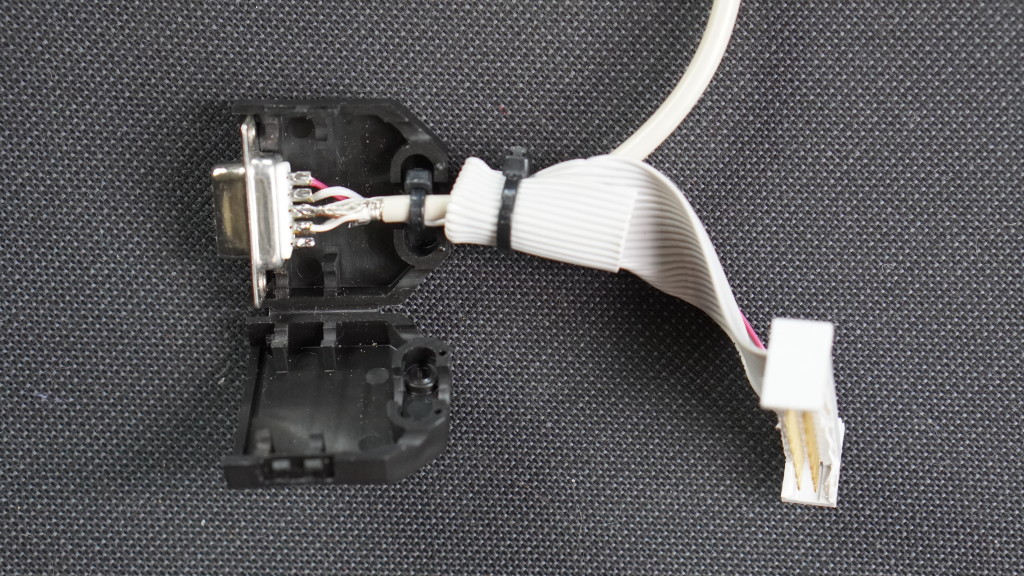
Here some more details an my cable:
Am Montag, dem 19.01.2026 um 10:22 +0100 schrieb Chris van
der Meijden via OvmsDev:
Hi Michael,
the connector you found looks good.
I used a 26-pin PC IDC cable and cut the box. The pitch is 2,54 mm.
https://www.goingelectric.de/forum/viewtopic.php?p=1186816#p1186816
It fits perfectly in the t26 socket, but sits loose. I fixated it with an elastic band.
This works for almost 6 years now in the car, so I never bothered to look for a better solution.
For DIY it is cheap and works well. For a more professional, sellable, cable the VW connector seems to be worth a try I think.
Regards
Chris
Am Montag, dem 19.01.2026 um 09:59 +0100 schrieb Michael Balzer via OvmsDev:I think there is no standard male counterpart for the T26 connector.
The connector is used for other devices as well it seems, I'm pretty confident it's VW OE part no. 7L6 972 726 A, which is also used for the VW RNS-510 navigation system:
→https://kufatec.com/en/repair-kit-connector-26-pin-7l6-972-726-plug-housing-for-vw-audi-seat-skoda-rns-510/38171-1
This connector appears to be only meant for cables to be plugged into a custom shaped casing hole of a device, exposing a 2x13 board pin header, with the casing providing the mounting side for the white lock lever.
So we will need to use some standard 2x13 male ribbon connector, combined with something to suitably secure the connection (there is no movement stress on the cable under the seat, doesn't need to be strong).
IIRC the T26 plug is also thicker than a standard ribbon connector. Chris, did you find an extra wide boxed 2x13 connector fitting the T26 plug without cutting the box?
If not we should probably better use an unboxed variant.
Also, was that standard 2.54mm or 2mm pitch on the connector?
Regards,
Michael
Am 27.11.25 um 09:38 schrieb Mark Webb-Johnson via OvmsDev:
I agree that tapping wires is not a good solution for general users. Something more reversal much more appropriate.
Anyway, if someone can get me pinouts, a link to the connector, and cable lengths, I can get talk to the factory.
Regarding the antenna, I am a little concerned because our certifications are limited on antenna types. In particular I remember some clauses in there regarding not using ‘combined’ antennas (as they void the RF testing we did), but also limitations regarding distance between the antenna and driver/passenger head (which we came close to in the Tesla Roadster rear-window antenna placement).
Regards, Mark
On 26 Nov 2025, at 4:50 PM, Chris van der Meijden via OvmsDev <ovmsdev@lists.openvehicles.com> wrote:
That seems the best approach to me too for a prefabricated cable.
I hope somebody can provide the exact lengths for the cables, otherwise it is going to be guesing by rough meassuring the distances in the car.
Am Mittwoch, dem 26.11.2025 um 09:20 +0100 schrieb Michael Balzer via OvmsDev:
My 2 cents:
I think tapping into wires (variant 2 / footwell panel) isn't something we should suggest / encourage users to do.
A regular user is perfectly capable of unmounting the passenger seat and plugging in prefabricated connectors. That also is easily reversible, and using the original antennas for the OVMS is really neat as well.
So I'd vote for variant 1 (combined with OBD), with a long cable to mount the OVMS module in the front left near the OBD connector (i.e. not replacing the OCU under the passenger seat), and the kit for that could/should include the Fakra antenna plug/adapter with antenna cables of the appropriate length to connect to the module in the front.
@Mark: for clarification, this image shows a very short T26 connection meant to place the OVMS under the passenger seat near the T26 connector, replacing the OCU:
This does not apply when mounting the module in the front near the OBD port.
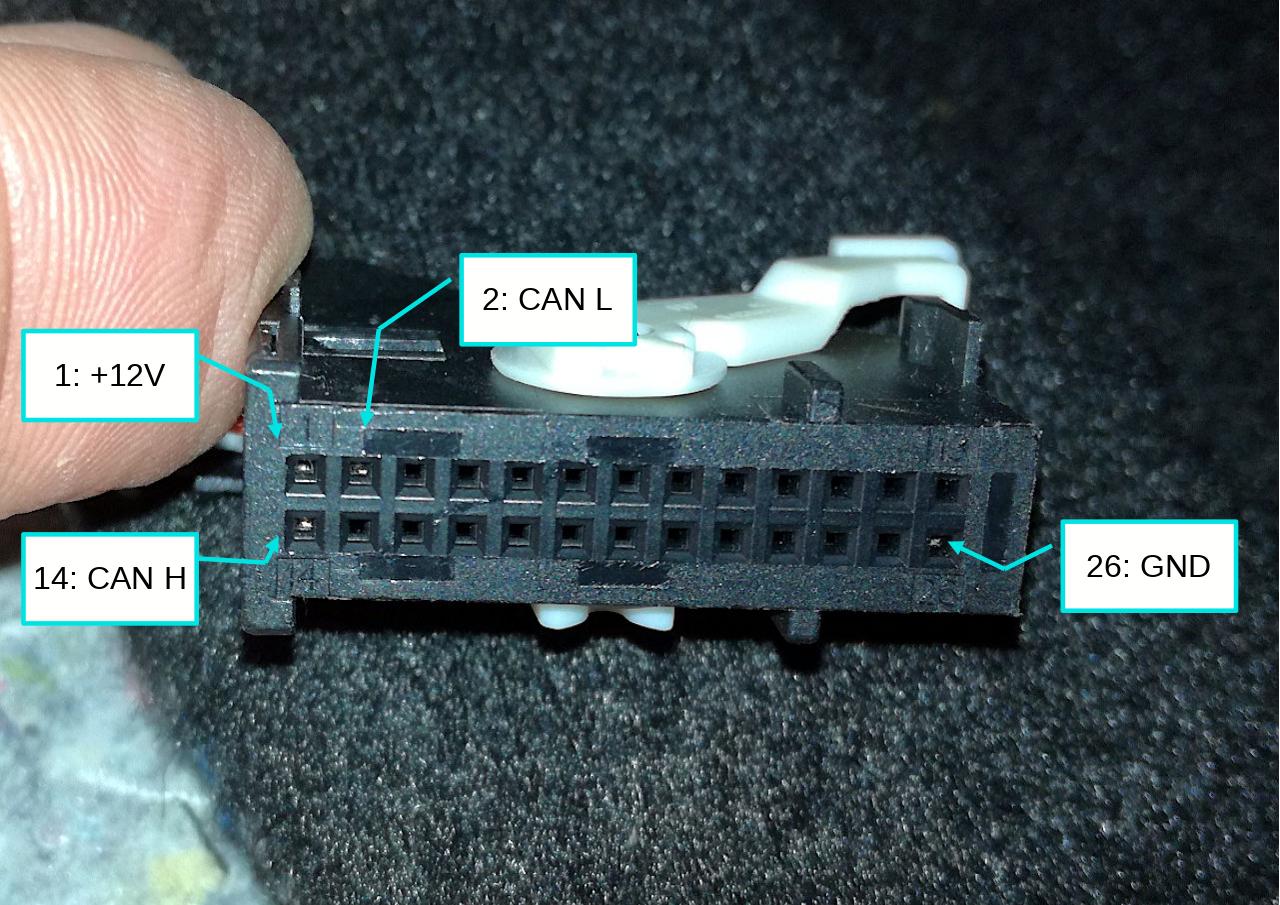
Taking +12V from the OBD port, the T26 connection cable then only needs to connect GND and CAN-L, CAN-H of the T26 connector:
This image shows the vehicle side of the T26 connector, i.e. the OVMS cable needs to be plugged into that.
It would be nice if the OVMS plug could also be secured by using the white lock lever shown, that's what Chris intends by using some original T26 part for this. Maybe there are compatible connectors available, but other ways to secure the connection would also be OK.
Can't help with the cable lengths needed for a proper installation, I still haven't done that connection other than by a flying CAT5 cable for re-engineering…
Regards,
Michael
Am 26.11.25 um 08:15 schrieb Chris van der Meijden via OvmsDev:
Hi Mark,
as I started the e-Up OVMS project years ago my first approach was the T26 cable. The reason for that more complicated cable was that with the direct connection to CAN3, I was able to get write access for i.e. climate control.
My way to do so was replacing the VW TCU under the passenger seat and connect to the VW T26 connector there (hence the name T26).
As the project developed the direct ODB access was added by other very capable developers to gain more data from the car. So we ended up with 4 cables. T26 alone, ODB alone, ODB + T26 under the passenger seat, ODB + T26 at the passenger footwell panel.
T26 alone and ODB alone have only historical value, so there needs to be a decission, if you want to make the hybrid cable for under the passenger seat or at the passenger footwell panel.
The advantage of the "under the seat" cable is, that you can use the GPS and GSM antenna of the car. Disavantage is, the you have to struggle with the seat. The "footwell" cable is much easier to install, but OVMS will need extra antennas for GPS and GSM.
I would suggest, that the decission about what cable to make should be discussed here briefly first.
Then someone will probably be able to provide the length of the cable.
Information on the connector, wire type and pinouts are in the documentation. The connector is a workaround as we were not able to find the original female T26 plug. But perhaps things has changed and somebody has more information on that now.
Hope this is of some help.
Regards
Chris
Am Mittwoch, dem 26.11.2025 um 10:49 +0800 schrieb Mark Webb-Johnson via OvmsDev:
We’ve had some enquiries regarding making a standard OVMS cable T26 for VW eUP, Skoda E IV, and Seat MII electric.
From my understanding, the cable is variant 1 described here:
If there anybody here knowledgeable about this, that could help specify the cable exactly? Things like:
- Exact T26 connector
- Length of each cable segment
- Cable wire type
- Pinouts
Preferable somebody who has already done it and can document exactly what they have.
Also presumably this requires unplugging the existing OCU, and what is the impact of that?
Regards, Mark.
_______________________________________________
OvmsDev mailing list
_______________________________________________OvmsDev mailing listOvmsDev@lists.openvehicles.comhttp://lists.openvehicles.com/mailman/listinfo/ovmsdev
_______________________________________________
OvmsDev mailing list
OvmsDev@lists.openvehicles.com
http://lists.openvehicles.com/mailman/listinfo/ovmsdev
_______________________________________________OvmsDev mailing listOvmsDev@lists.openvehicles.comhttp://lists.openvehicles.com/mailman/listinfo/ovmsdev
_______________________________________________
OvmsDev mailing list
_______________________________________________ OvmsDev mailing list OvmsDev@lists.openvehicles.com http://lists.openvehicles.com/mailman/listinfo/ovmsdev